
Codex code review in GitHub
For the complete documentation index, see llms.txt. Markdown versions of documentation pages are available by appending
.mdto the page URL.
Use Codex code review to get another high-signal review pass on GitHub pull requests. Codex reviews the pull request diff, follows your repository guidance, and posts a standard GitHub code review focused on serious issues.
<YouTubeEmbed title="Codex code review walkthrough" videoId="HwbSWVg5Ln4" class="max-w-md mr-auto" />
Before you start
Make sure you have:
- Codex cloud set up for the repository you want to review.
- Access to Codex code review settings.
- An
AGENTS.mdfile if you want Codex to follow repository-specific review guidance.
Set up Codex code review
- Set up Codex cloud.
- Go to Codex settings.
- Turn on Code review for your repository.
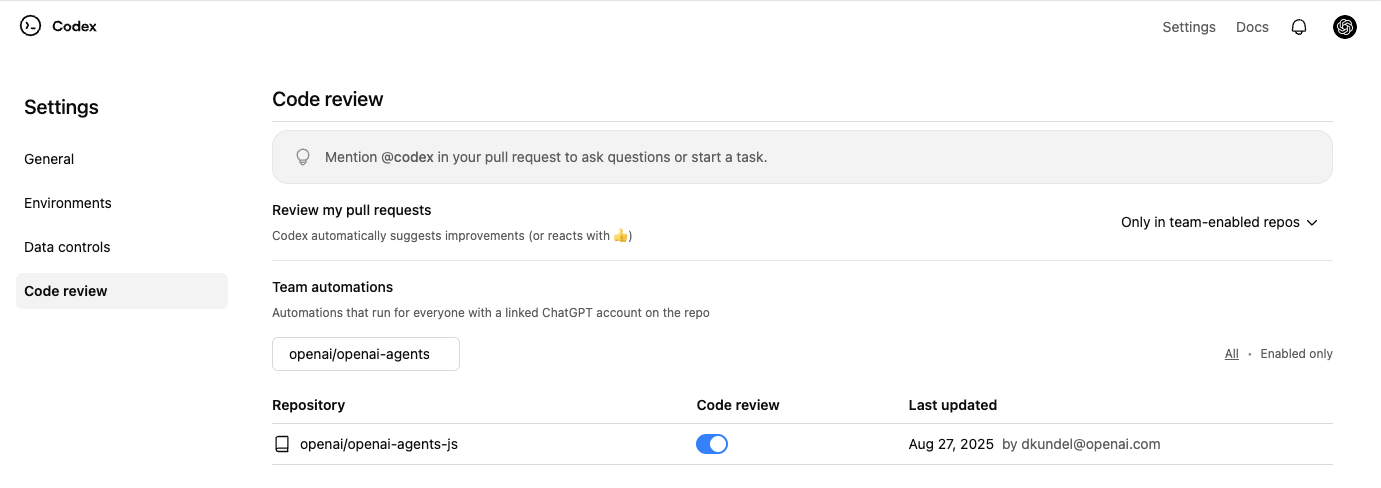
Request a Codex review
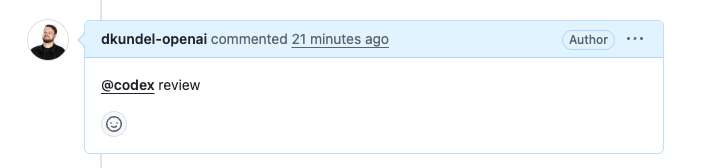
- In a pull request comment, mention
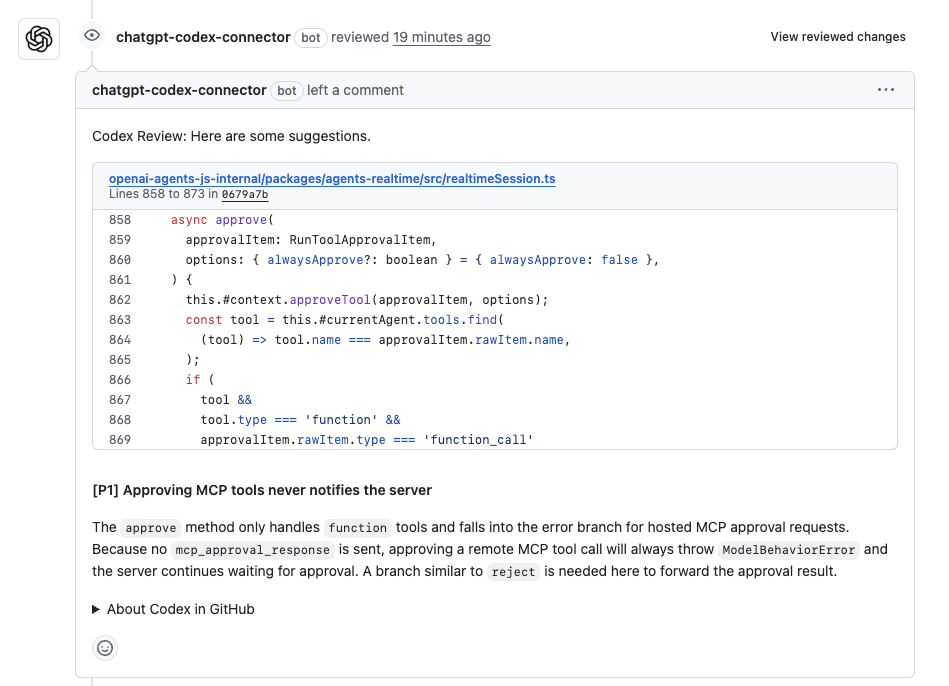
@codex review. - Wait for Codex to react (👀) and post a review.
Codex posts a review on the pull request, just like a teammate would. In GitHub, Codex flags only P0 and P1 issues so review comments stay focused on high-priority risks.
Enable automatic reviews
If you want Codex to review every pull request automatically, turn on
Automatic reviews in Codex settings.
Codex will post a review whenever someone opens a new PR for review, without
needing an @codex review comment.
Customize what Codex reviews
Codex searches your repository for AGENTS.md files and follows the applicable
code review rules. Add a ## Code Review Rules section to the file closest to
the code the rules govern. Use ### headings to group related checks when
helpful.
For example, an experiment-reporting service can keep post-exposure behavior from changing a comparison cohort:
## Code Review Rules

### Experiment cohorts

- Do not filter treatment comparisons on post-exposure behavior, including conversion or retention.
  Safe path: build cohorts from assignment or exposure; report conversion as an outcome.
Put repository-wide rules in the root AGENTS.md and service-specific rules
in a nested file, such as services/experiment_reporting/AGENTS.md. Codex
applies the root and more-specific guidance that covers each changed file, so
unrelated changes don't have to carry service-specific context.
Start with two or three concise rules that encode checks reviewers often explain. Useful rules:
- Focus on consequential, repository-specific behavior. Describe the compatibility constraint, data boundary, or unsafe side effect to flag and why it matters.
- State the safe path or exception. Give Codex enough context to distinguish a real issue from expected behavior.
- Keep rules scoped and durable. Prefer outcomes over function names that can change, and place guidance near the code it governs.
- Leave mechanical checks in CI. Keep formatting, lint, and other deterministic checks out of review rules.
Open a representative pull request and request a review with @codex review.
Refine the rules based on the findings and feedback you see, and narrow or
remove guidance that produces noise.
Code review rules guide Codex; they don't replace tests, branch protections, or required approvals.
For a one-off focus, add it to your pull request comment:
@codex review for security regressions
Act on review findings
After Codex posts a review, you can ask it to fix issues in the same pull request by leaving another comment:
@codex fix the P1 issue
Codex starts a cloud chat with the pull request as context and can push a fix back to the branch when it has permission to do so.
Give Codex other tasks
If you mention @codex in a comment with anything other than review, Codex starts a cloud chat using your pull request as context.
@codex fix the CI failures
Troubleshoot code review
If Codex doesn't react or post a review:
- Confirm you turned on Code review for the repository in Codex settings.
- Confirm the pull request belongs to a repository with Codex cloud set up.
- Use the exact trigger
@codex reviewin a pull request comment. - For automatic reviews, check that you turned on Automatic reviews and that the pull request event matches your review trigger settings.