name: Validate bulk RNA-seq inputs tagline: Validate bulk RNA-seq inputs before differential expression. summary: Use ChatGPT with the NGS Analysis plugin to validate sample sheets, FASTQs, and references, then return MultiQC, Salmon matrices, provenance, and a short QC interpretation before differential expression. skills:
-
token: NGS Analysis url: codex://plugins/ngs-analysis@openai-curated description: Validate sequencing inputs, run bulk RNA-seq counts and QC, and return auditable artifacts. bestFor:
-
Bioinformatics teams validating bulk RNA-seq inputs before differential expression.
-
Researchers who want transcript and gene-level quantification plus QC in one chat.
-
Teams that need mapping-rate, duplication, library-type, and resource-readiness review. starterPrompt: title: Run Bulk RNA-seq Counts and QC body: >- Use the NGS Analysis plugin.
Run bulk RNA-seq FASTQ-to-count QC on the provided sample sheet, FASTQ root, transcriptome FASTA, genome FASTA, and GTF.
Return:
-
run_manifest.json
-
MultiQC plus browser-safe review links
-
Salmon transcript- and gene-level matrices
-
validation and resource-readiness artifacts
-
a short QC interpretation that calls out mapping rate, duplication, library-type agreement, outlier samples, and anything that would block downstream differential expression suggestedEffort: high relatedLinks:
-
-
label: Request access to GPT-Rosalind url: https://openai.com/form/life-sciences-access/
For the complete documentation index, see llms.txt. Markdown versions of documentation pages are available by appending
.mdto the page URL.
Leverage skills
The NGS Analysis plugin includes:
ngs-analysis-routerngs-bulk-rnaseq-counts-qcngs-runtime-env
When you use the plugin, ChatGPT can use all these packaged skills.
Step-by-step guide
- Point ChatGPT to a directory with the sample sheet, FASTQs, transcriptome FASTA, genome FASTA, and GTF, or provide exact file references.
- Run the starter prompt so ChatGPT can validate strandedness, reference consistency, and tool readiness before execution.
- Open the generated MultiQC and matrix artifacts in ChatGPT to review mapping rate, duplication, library-type agreement, and resource readiness.
- Continue in the same chat to fix blockers, rerun with updated metadata, or hand the resulting gene-level matrices into downstream differential expression.
Results
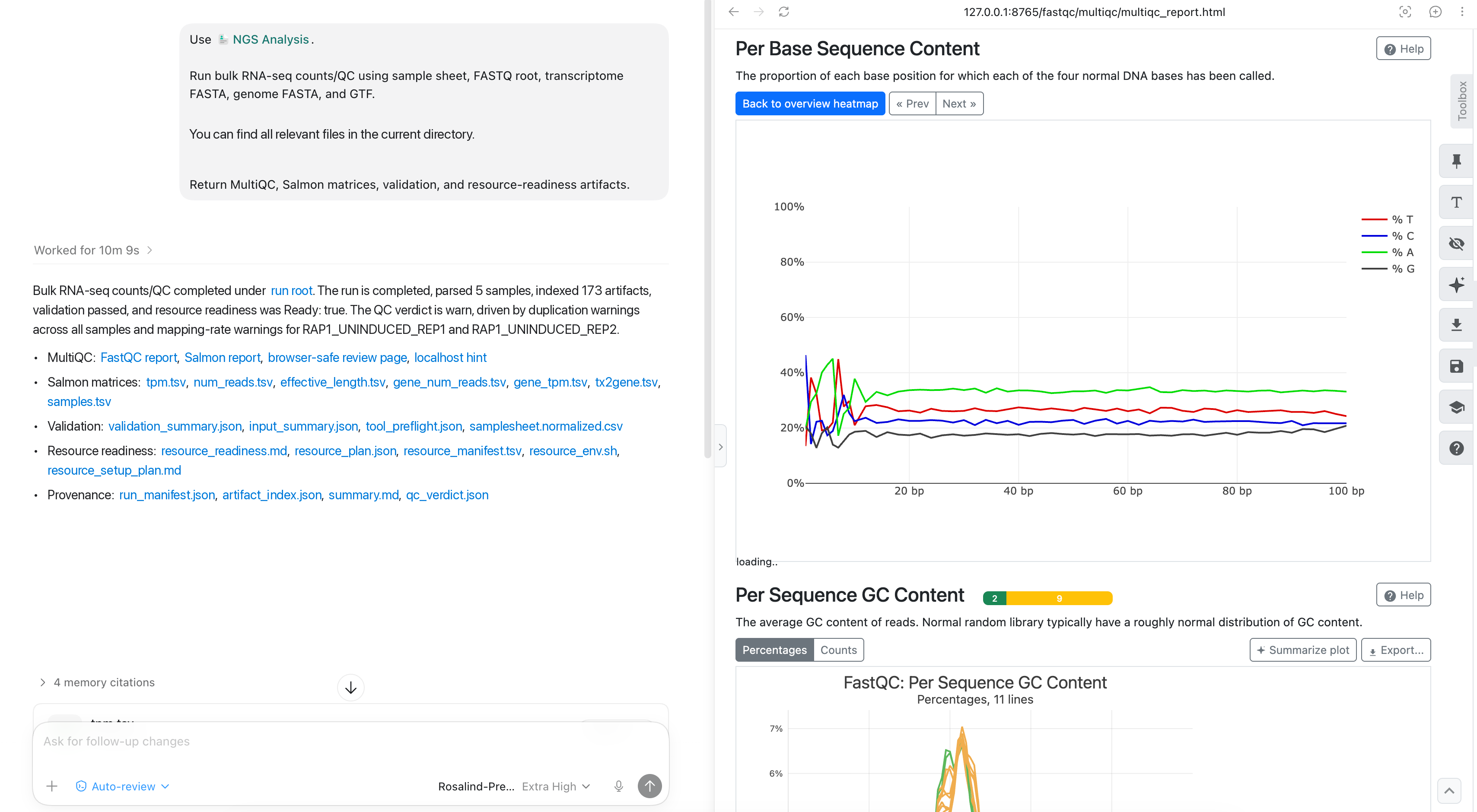
The run returns a QC-reviewed counts bundle rather than a bare quantification output. Start with the MultiQC report to identify warnings that could affect downstream interpretation. In this example, ChatGPT surfaces FastQC sequence-content warnings alongside the run summary so the team can decide whether the observed pattern is expected for the library preparation.
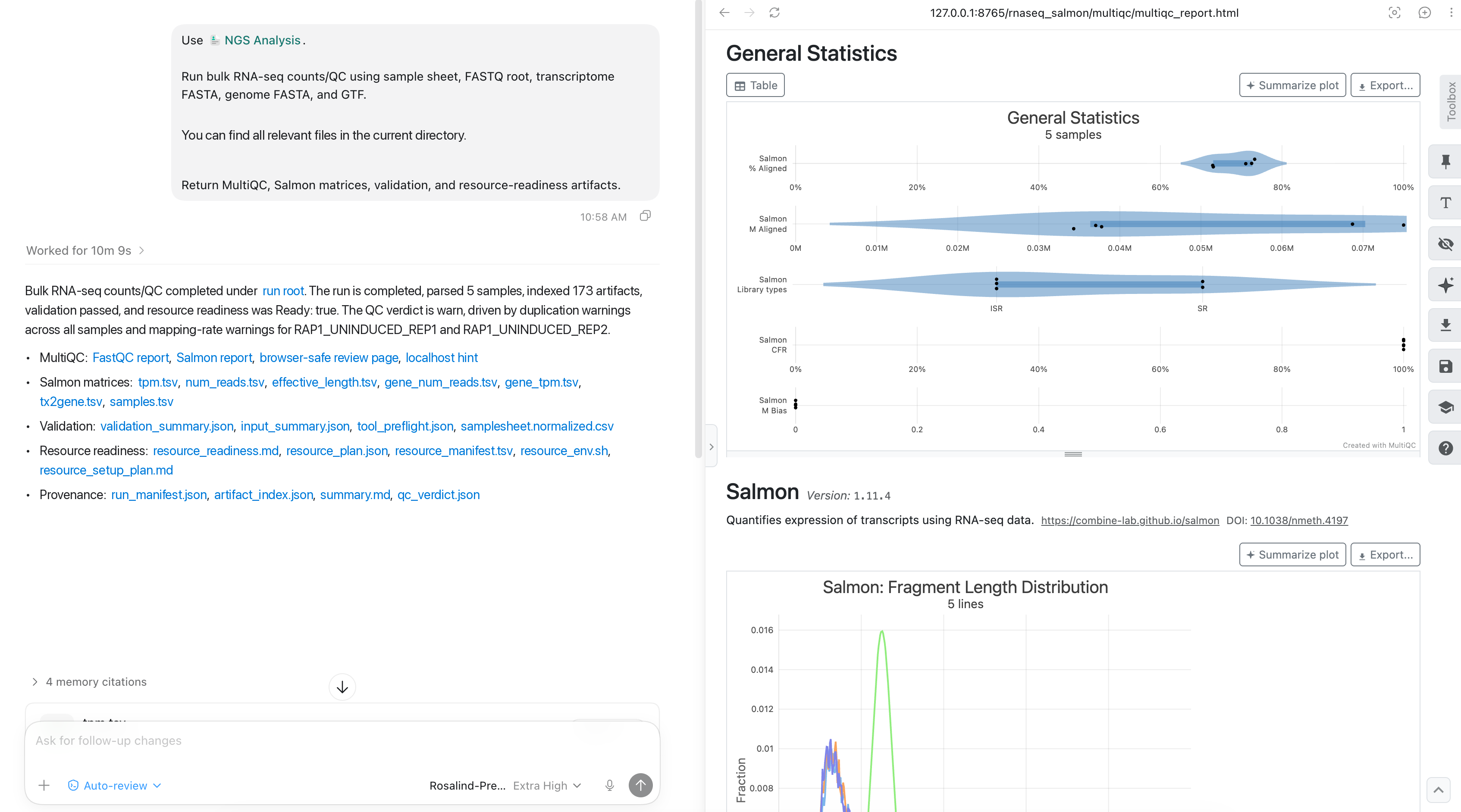
Next, review the Salmon statistics in the same report. Mapping rates, library-type assignments, and duplication signals provide a compact readiness check before differential expression.
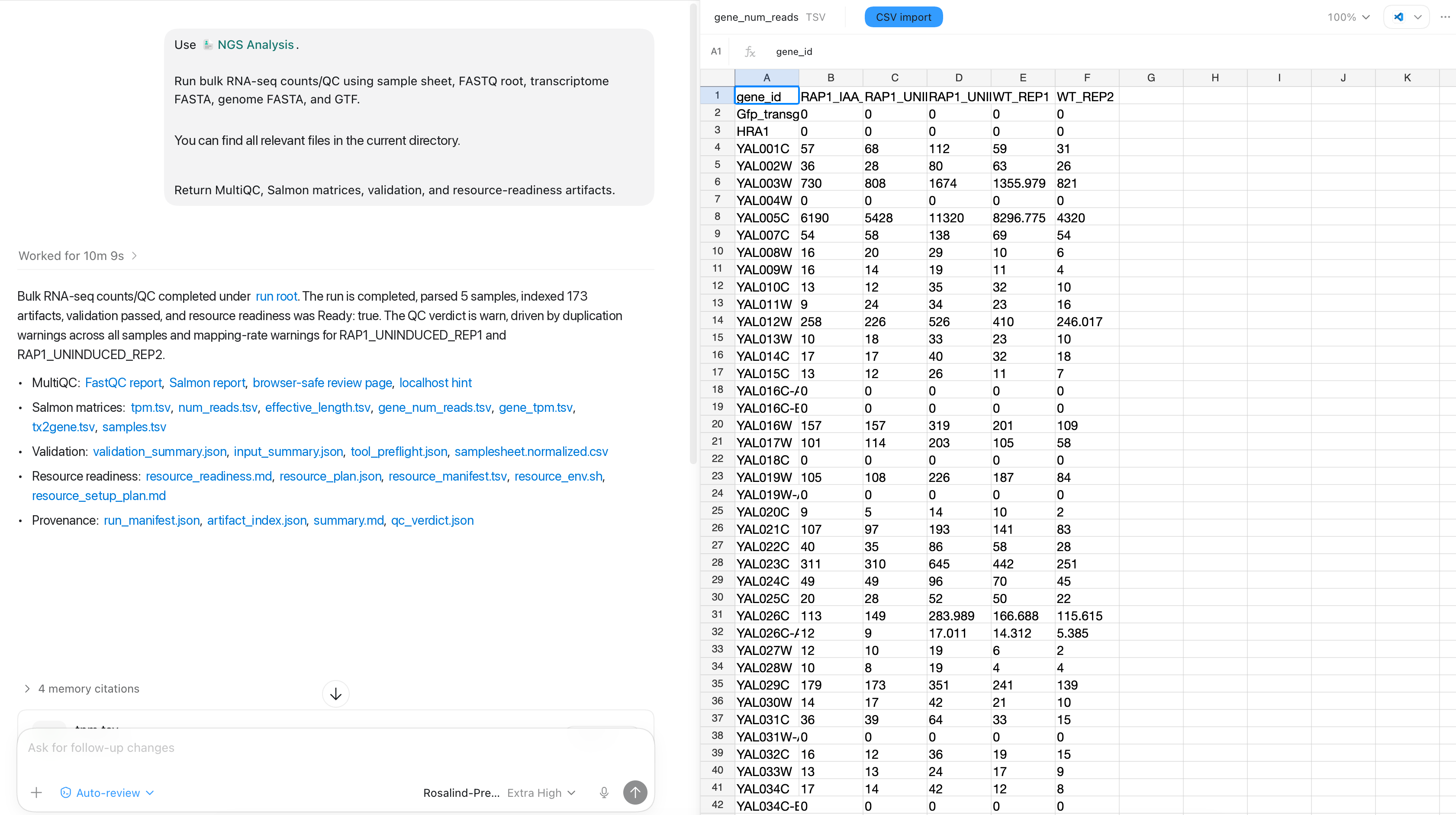
The resulting gene-level count matrix is saved as a reusable artifact. Open it in ChatGPT to confirm the expected samples and features are present, then keep it with the run provenance for downstream analysis.