
Sites administration
For the complete documentation index, see llms.txt. Markdown versions of documentation pages are available by appending
.mdto the page URL.
For current workspace setup, permissions, and availability, see Managing ChatGPT Sites for your workspace in the Help Center.
Use this guide to decide who can create, change, and use sites in your workspace, and how your organization reviews and maintains them. To build or use a site, see Sites.
Before you begin
Sign in to the workspace you administer. Decide who should create and publish sites, which audiences are appropriate, and who will handle review, support, and removal requests.
Start with a specific use case. For example, an onboarding site that displays approved reference material needs a different review from a request tracker that collects employee information or a dashboard that uses connected apps. Agree on:
- The intended audience and whether external or public access is appropriate.
- The information the site displays, collects, stores, or sends to another service.
- The people responsible for the site's content, application behavior, and ongoing support.
- The review required before first publication and after material changes.
How sites work
A site can contain pages, application code, and visitor information. Review what it publishes and collects before sharing it. For the builder's workflow, see Create a site.
What you can build
Sites can support reference pages, forms, trackers, and interactive dashboards. The review should follow what the application does. A reference page needs a content and audience review. A form also needs a decision about which submissions to collect and who can read them. A connected dashboard needs a review of the accounts, permissions, and information used by its connections.
Information stored or exposed by a site
Information from prompts, conversation context, and uploaded or referenced files can become part of a site. Check the resulting pages, sample records, downloads, and generated content for information that should not reach the intended audience.
Distinguish information copied into a site from information retrieved through a connection. For example, an uploaded spreadsheet can become a shared snapshot. A visitor using their own connected account may have different access from the person who built the site. Test the resulting behavior; the creator's preview alone does not establish what another visitor can see.
For the builder workflow, see Data and connections.
For hosting and processing providers, see OpenAI's sub-processor list.
Enable sites and permissions
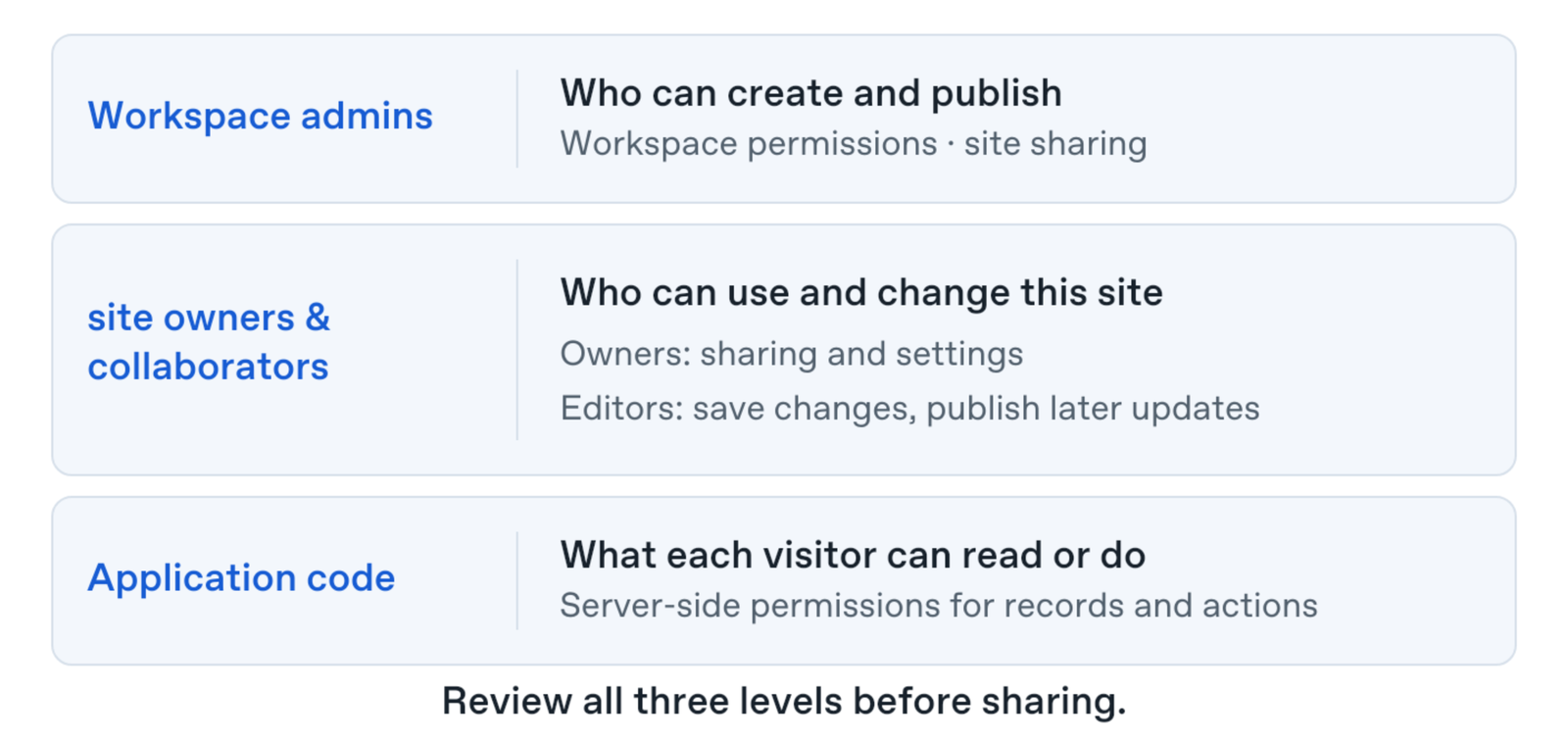
Review three levels of control: workspace permissions, the site's sharing and editing permissions, and permissions implemented by the application.
Workspace admin controls
Workspace permissions govern who can create and publish sites. Public publishing is off by default in Enterprise. To let members invite named external visitors, enable Allow members to invite external visitors to sites under Workspace settings > Permissions & roles. You can allow these invitations while keeping public publishing off.
In Business workspaces, external invitations are available when sites are enabled and the account has access to the feature. Business has no separate external-invitation setting.
For configuration steps and current role permissions, follow the workspace administration guidance.
Site owner and collaborator controls
The site owner chooses visitors and editors within the limits you set for the workspace.
Audience and sharing
When reviewing a site's audience, check individual invitations, group access, workspace-wide sharing, and public access. More than one of these methods can give the same person access. Owners can choose who can visit or invite external visitors.
Editors and collaboration
Review who has edit access. After the owner publishes for the first time, editors can publish updates without separate owner approval. Agree on how they should request and record any review your organization requires. For editor permissions and invitations, see Collaborate on a site.
Application permissions
Site access and access to individual records are separate. For private application data, enforce record access in server-side code and test with ordinary visitor accounts.
For example, a request tracker might let every workspace member open the site while allowing each person to see only their own requests. The application needs to check that rule when returning a record or accepting an action. Hiding a page element does not enforce the rule. Test with separate accounts that should and should not have access to the same record.
Configure connections
Creating or sharing a site does not itself authorize connected-app access. Review organization approval, plugin settings, and each visitor's connected account and permissions in the Help Center connected-app guidance.
Include connections in the site's review. Identify which services it uses, what information it requests, and who should authorize that access. Keep the site's audience decision separate from the connected service's permissions.
Keep credentials out of prompts, attachments, and visible site content.
Verify the visitor experience
Keep connected sites private to their workspace. Before sharing a connected site more widely within that workspace, test with another eligible workspace member who uses their own connected account. Confirm that the site shows information appropriate to that person's existing permissions.
Also test what the site shows when a visitor declines access. It should identify which features need the connection and distinguish unavailable data from a successful result. For the visitor steps, see Let visitors choose their connections.
Review and manage sites
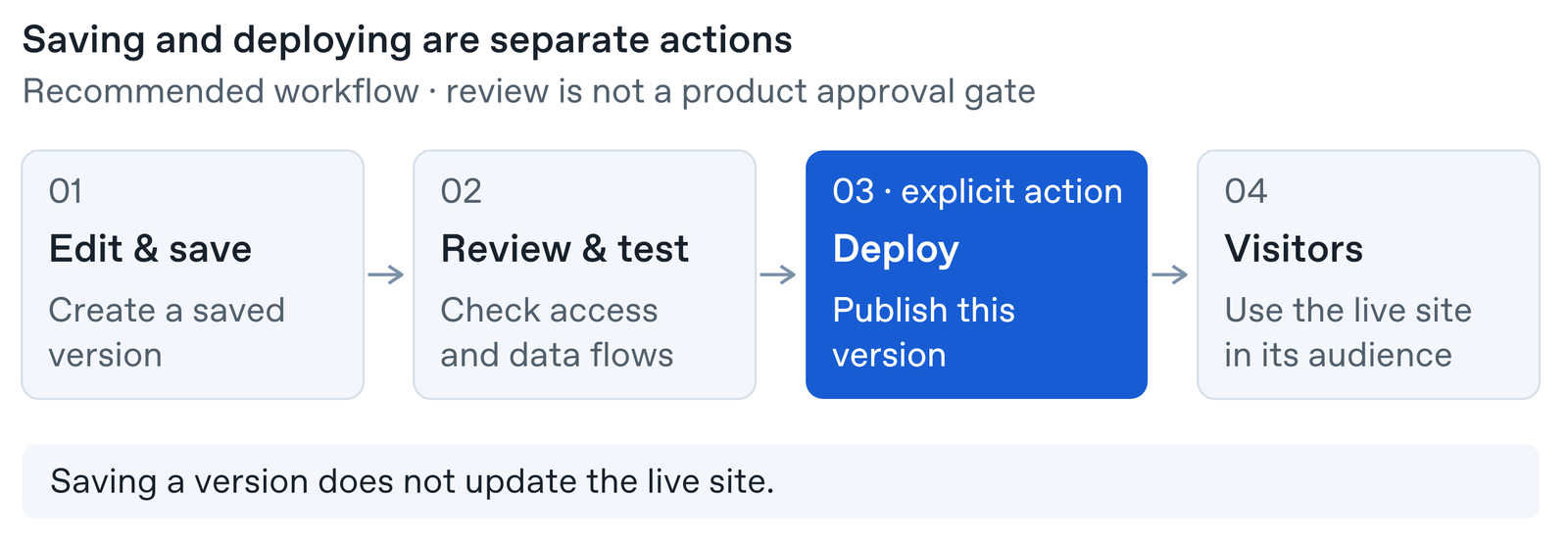
Saved versions and publishing
Decide who should review a saved version before it goes live. Your organization sets this review process. An owner or eligible editor can publish without a separate approval in Sites. For the publishing steps, see Publish an update.
Shared responsibilities
Assign reviewers for the site's content, access rules, generated code, and connected services. Choose people who know the data and the intended use.
Review before publishing
Ask the site owner to review the site before sharing. Have your reviewers run these checks before the first publication and after material changes.
- Verify that the intended audience can open the site and that excluded visitors cannot.
- Test record access with separate accounts. For example, if a form collects private requests, check whether one visitor can read or change another visitor's submission.
- Check what forms collect, where submissions go, who can see them, and how visitors can ask questions about their data.
- Check which services the site connects to, what access it requests, and whether pages, downloads, or error messages disclose sensitive information.
Ongoing maintenance
Give each production site an owner and a reporting route for access, data, or service issues. Plan ownership handoffs and retirement with your workspace admin.
Revisit the review when the site gains a new audience, editor, data source, connection, form, or application feature. Periodically check whether the audience and editor list still match the site's purpose, whether its content is current, and whether its connections still work for intended visitors.
Troubleshoot access
Start with the affected person's account, role, and attempted action. A creator's successful preview does not confirm that another person can view, edit, publish, or use a connection.
| Symptom | What to check |
|---|---|
| A member cannot create or publish a site | Confirm the active workspace, feature availability, and permissions for that member's role. |
| A visitor cannot open a site | Check the site's audience and whether the visitor is signed in with the account that received access. |
| An editor cannot publish | Check edit access, workspace permissions, and whether the owner has completed the first publication. |
| A connection works for the creator but not another visitor | Confirm that the site is private to its workspace and the visitor belongs to that workspace. Check the visitor's connected account, service permissions, authorization, and the applicable organization and plugin settings. |
| A person can still view a site after an invitation is removed | Review remaining group, workspace-wide, or public access. |
| A published site does not show an expected edit | Confirm that the intended version was published, then open the live site to check the result. |
To review available workspace controls or troubleshoot access, follow the Help Center guidance.
Security and privacy
Check current hosting, residency, and data requirements against your organization's policies before choosing what information to store in a site.
Visitor privacy and personal information
Before adding a form, sign-in feature, or other way to collect visitor information, decide why the site needs that information and how the site will use it. Review who can access submissions and whether the site will send information to another service or display it to other visitors.
Plan the appropriate privacy notice and a contact route for visitor questions. Use the resources below with your organization's privacy reviewers to determine what the notice and handling process should cover.
For responsibilities and privacy guidance, review these resources:
- Review ChatGPT Sites Terms.
- Review Operator responsibilities.
- Review Data-protection responsibilities.
- Review Privacy-policy guidance.
Before an owner changes roles or leaves, identify who will maintain the site and use the current administration guidance for available handoff options. For retirement, plan how to restrict access and handle information collected by the site. Confirm deletion and retention requirements before promising a recovery or removal timeline.
For retention or deletion questions, contact OpenAI Support.
For access questions, contact OpenAI Support. Include the site URL, workspace, affected role, attempted action, time, and error details. Omit secrets and access tokens.